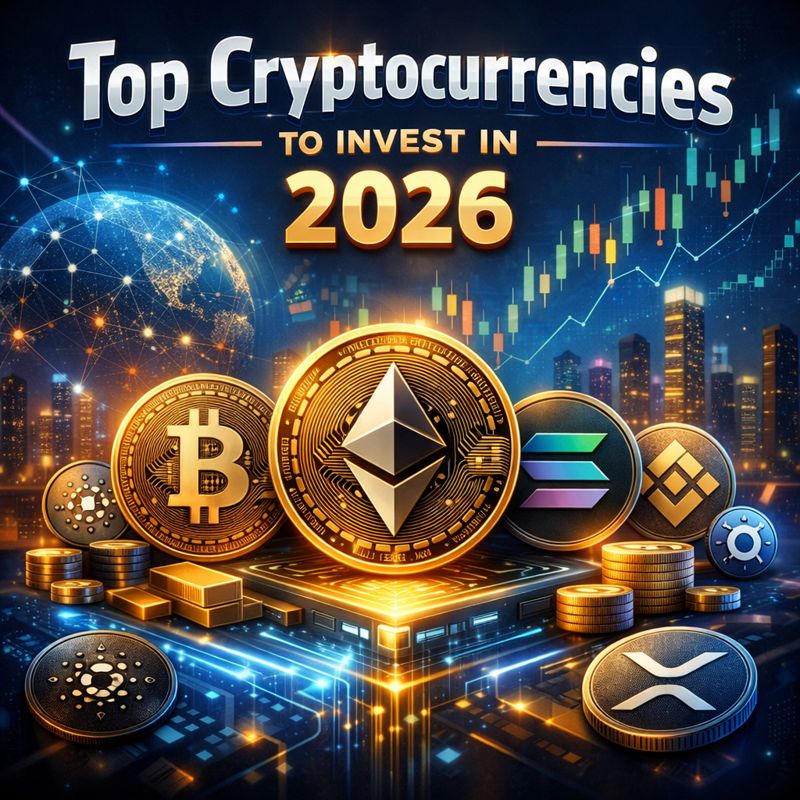
The cryptocurrency market in 2026 is more mature, regulated, and institutionally adopted than ever before. What started as a niche technology has evolved into a global financial ecosystem that includes decentralized finance (DeFi), NFTs, tokenized real-world assets, blockchain gaming, artificial intelligence integrations, and cross-border payment solutions.
However, with thousands of cryptocurrencies available, choosing where to invest requires careful analysis. In this guide, we explore the best cryptocurrencies to consider for investment in 2026, focusing on long-term fundamentals, real-world utility, adoption, and innovation.
Disclaimer: This article is for informational purposes only and does not constitute financial advice. Always conduct your own research before investing.
1. Bitcoin (BTC): The Cornerstone of Crypto Investing
Bitcoin remains the most dominant and influential cryptocurrency in the world. Often referred to as “digital gold,” Bitcoin is primarily valued as a store of value rather than a utility token. Its fixed supply of 21 million coins creates scarcity, which continues to attract both retail and institutional investors.
In 2026, Bitcoin benefits from:
- Institutional adoption through ETFs and regulated investment products
- Increasing use as a hedge against inflation and currency devaluation
- Growing acceptance by governments and large corporations
Despite its volatility, Bitcoin’s long-term trend and market dominance make it a must-have asset in most crypto portfolios.
Best for: Long-term investors, portfolio stability, and value preservation.
2. Ethereum (ETH): The Foundation of Web3
Ethereum is far more than a cryptocurrency — it is a global decentralized computing platform. Ethereum powers most of the Web3 ecosystem, including decentralized applications (dApps), DeFi protocols, NFTs, and DAOs.
Since transitioning to Proof of Stake, Ethereum has:
- Reduced energy consumption significantly
- Improved scalability through Layer-2 solutions
- Introduced deflationary mechanisms that reduce ETH supply over time
In 2026, Ethereum continues to attract developers, enterprises, and institutional capital, reinforcing its role as the backbone of decentralized innovation.
Best for: Investors seeking exposure to Web3, DeFi, and smart contract infrastructure.
3. Solana (SOL): High-Performance Blockchain for Mass Adoption
Solana has established itself as one of the fastest and most cost-efficient blockchains on the market. With near-instant transactions and extremely low fees, Solana has become a favorite for DeFi platforms, NFT marketplaces, and blockchain gaming projects.
Key advantages of Solana include:
- High transaction throughput
- Low latency and minimal fees
- Rapid ecosystem growth and developer adoption
While Solana has faced technical challenges in the past, ongoing upgrades and increased network stability make it a strong contender in 2026.
Best for: Growth-oriented investors and high-performance blockchain exposure.
4. Binance Coin (BNB): Exchange-Driven Utility and Growth
BNB is the native token of the Binance ecosystem, one of the largest crypto platforms globally. Its value is driven by strong utility across trading, staking, DeFi applications, and blockchain services on BNB Chain.
Reasons BNB remains relevant in 2026:
- Used to pay trading fees at discounted rates
- Regular token burns that reduce supply
- Extensive use across DeFi, NFTs, and launchpads
BNB’s performance is closely tied to the success of the Binance ecosystem, making it a unique hybrid between a utility token and an exchange-backed asset.
Best for: Investors interested in exchange ecosystems and utility-based tokens.
5. Chainlink (LINK): Connecting Blockchains to the Real World
Chainlink is a critical infrastructure project that provides decentralized oracles, enabling smart contracts to access real-world data such as prices, events, and APIs.
As blockchain adoption grows, the demand for secure and reliable data feeds increases. Chainlink is widely used across:
- DeFi protocols
- Cross-chain applications
- Tokenized real-world assets
In 2026, Chainlink’s role as a core Web3 service positions it as a long-term investment with strong fundamentals.
Best for: Infrastructure-focused investors and long-term tech believers.
6. Polkadot (DOT): The Future of Blockchain Interoperability
Polkadot was designed to solve one of blockchain’s biggest challenges: interoperability. Instead of competing with other blockchains, Polkadot connects them, allowing data and assets to move seamlessly across networks.
Key features of Polkadot include:
- Parachains for scalability and customization
- Shared security across the ecosystem
- Strong governance and upgrade mechanisms
As multi-chain ecosystems become the norm in 2026, Polkadot’s vision becomes increasingly relevant.
Best for: Investors focused on long-term blockchain architecture and interoperability.
7. Cardano (ADA): Research-Driven and Sustainable Growth
Cardano stands out for its academic and research-based development approach. The project emphasizes security, scalability, and sustainability, making it appealing for governments and enterprise use cases.
Cardano’s strengths include:
- Peer-reviewed development model
- Strong focus on emerging markets
- Smart contracts and decentralized identity solutions
Although development is slower compared to competitors, Cardano’s methodical approach appeals to long-term investors.
Best for: Conservative investors who value stability and academic rigor.
8. XRP: Fast and Cost-Effective Global Payments
XRP is designed to facilitate fast and inexpensive cross-border payments. It is widely used by financial institutions and payment providers looking to modernize international money transfers.
In 2026, XRP remains relevant due to:
- Extremely low transaction costs
- High transaction speed
- Strong focus on institutional finance
Regulatory clarity has played a key role in restoring investor confidence in XRP.
Best for: Investors focused on real-world financial adoption.
9. Emerging Crypto Trends to Watch in 2026
Beyond individual cryptocurrencies, investors should pay attention to major industry trends, including:
- Tokenization of real-world assets (real estate, stocks, commodities)
- AI and blockchain integration
- Decentralized identity solutions
- Blockchain gaming and metaverse platforms
Projects aligned with these trends may offer higher risk — but also higher reward.
Final Thoughts: Building a Smart Crypto Portfolio in 2026
Successful crypto investing in 2026 is about balance and strategy. A well-diversified portfolio often includes:
- Established assets like Bitcoin and Ethereum
- High-growth platforms like Solana
- Infrastructure projects such as Chainlink and Polkadot
Always remember:
- Diversify your investments
- Stay informed about market trends
- Never invest more than you can afford to lose
Cryptocurrency remains a volatile but highly innovative market. With the right research and a long-term mindset, 2026 can offer significant opportunities for informed investors.