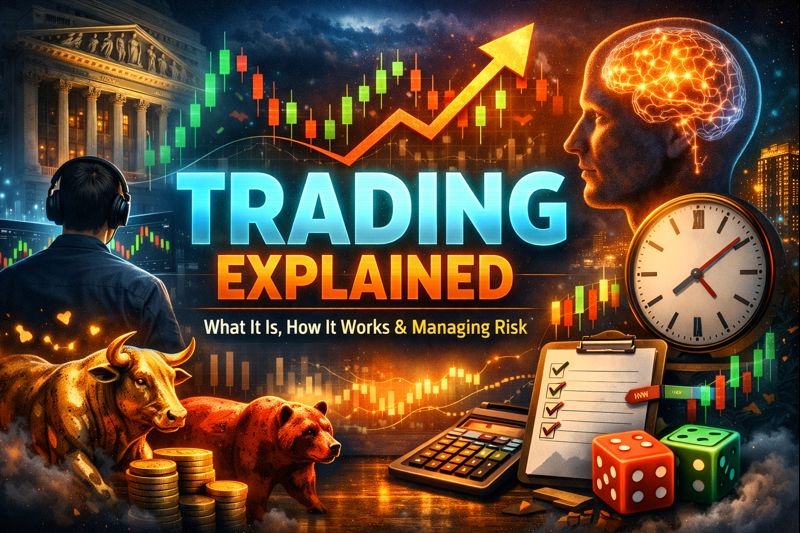
Trading is often portrayed as a mysterious world filled with flashing charts, complex indicators, and people staring intensely at multiple screens while sipping overpriced coffee. In reality, trading is something much more human, strategic, and fascinating. It is a blend of psychology, probability, discipline, and decision-making under uncertainty. Whether you are completely new or already familiar with the markets, understanding what trading really is can change the way you see money, risk, and even yourself.
In this article, we’ll explore trading from the ground up: what it is, how it works, why people do it, and what separates consistent traders from those who quit early. No boring textbook explanations—just a clear, engaging look at one of the most talked-about financial activities in the modern world.
What Is Trading, Really?
At its core, trading is the act of buying and selling financial assets with the goal of making a profit from price movements. These assets can include stocks, cryptocurrencies, forex (foreign exchange), commodities like gold or oil, indices, and more.
Unlike long-term investing, where the focus is on holding assets for years based on fundamental growth, trading is more active. A trader may hold a position for months, days, hours, or even seconds, depending on their style.
But here’s the key idea many beginners miss: trading is not about predicting the future perfectly. It’s about managing probabilities. Traders don’t need to be right all the time—they need to be right often enough, while controlling their losses when they’re wrong.
Why Trading Attracts So Many People
Trading has exploded in popularity over the last decade, and for good reason. Technology has made global markets accessible to almost anyone with an internet connection. You no longer need to work on Wall Street or have millions in capital to participate.
Some of the main reasons people are drawn to trading include:
- Freedom: Many traders are attracted by the idea of working from anywhere and being independent.
- Merit-based results: In trading, performance matters more than titles or background.
- Personal growth: Trading forces you to confront your emotions, habits, and discipline.
- Unlimited learning: Markets evolve constantly, which keeps things interesting.
That said, freedom comes with responsibility. Trading rewards discipline and punishes impulsive behavior very quickly.
The Different Styles of Trading
Not all traders trade the same way. In fact, choosing a trading style that fits your personality is one of the most important decisions you’ll make.
1. Day Trading
Day traders open and close positions within the same day. They aim to profit from short-term price movements and usually avoid holding trades overnight.
Pros:
- Fast feedback
- No overnight risk
- Exciting and dynamic
Cons:
- Requires focus and screen time
- Emotionally demanding
- Not ideal for everyone
2. Swing Trading
Swing traders hold positions for several days or weeks, aiming to capture larger market moves.
Pros:
- Less screen time
- More relaxed pace
- Suitable for people with other jobs
Cons:
- Overnight and weekend risk
- Requires patience
3. Scalping
Scalpers make many very small trades, often holding positions for seconds or minutes.
Pros:
- Many opportunities
- Minimal exposure per trade
Cons:
- High stress
- Requires precision and speed
4. Position Trading
This is closer to investing but still considered trading. Positions can be held for months.
Pros:
- Very low screen time
- Focus on big trends
Cons:
- Requires strong conviction
- Large market swings
The Role of Psychology in Trading
If trading were just about strategy, everyone with a good system would be profitable. But that’s not the case. Psychology is often the deciding factor between success and failure.
Common psychological challenges include:
- Fear: Closing winning trades too early or avoiding good setups
- Greed: Overtrading or risking too much
- Revenge trading: Trying to recover losses emotionally
- Overconfidence: Ignoring rules after a winning streak
Successful traders don’t eliminate emotions—they learn to manage them. They rely on rules, routines, and risk management to stay consistent even when emotions run high.
Risk Management: The Survival Skill
If there is one concept every trader must master, it is risk management. You can have an average strategy and still be profitable with good risk control. But even the best strategy will fail without it.
Key principles include:
- Never risk more than a small percentage of your account on a single trade
- Always know where you will exit if the trade goes wrong
- Accept losses as part of the game
- Focus on long-term consistency, not single trades
Professional traders think in terms of series of trades, not individual outcomes.
Trading Strategies: Simpler Than You Think
Many beginners believe they need dozens of indicators and complex formulas. In reality, most successful traders use simple, repeatable setups.
Popular approaches include:
- Price action
- Support and resistance
- Trend-following
- Breakout strategies
The real edge doesn’t come from complexity—it comes from execution, discipline, and experience.
The Learning Curve: What to Expect
Trading is not a get-rich-quick scheme, despite what social media might suggest. It is a skill that takes time to develop.
Most traders go through similar phases:
- Excitement and curiosity
- Early losses and confusion
- Strategy hopping
- Realization that discipline matters more than indicators
- Gradual improvement
Those who survive long enough to learn from mistakes are the ones who eventually see progress.
Is Trading for Everyone?
Trading can be rewarding, but it’s not for everyone—and that’s okay. It requires patience, emotional control, and a willingness to accept uncertainty.
If you enjoy learning, analyzing patterns, and improving decision-making, trading can be an incredibly valuable journey, even beyond money.
Final Thoughts
Trading is not just about markets—it’s about mindset. It teaches you how to think in probabilities, manage risk, and stay calm under pressure. While it can be challenging, it can also be deeply fulfilling for those who approach it with respect, realism, and discipline.
Whether you decide to trade actively or simply learn from the principles behind it, understanding trading gives you a new perspective on money, behavior, and opportunity in the modern world.
And that alone makes it worth exploring.